
ENCARNACION PEÑA
Jose Encarnacion Peña (1902-1979, also known as Soqween was a Native American painter from San Ildefonso Pueblo. Works by Peña are available through Trotta-Bono Contemporary, a by-appointment gallery specializing in contemporary Native American art in Santa Monica, California.
— SELECTED WORK —
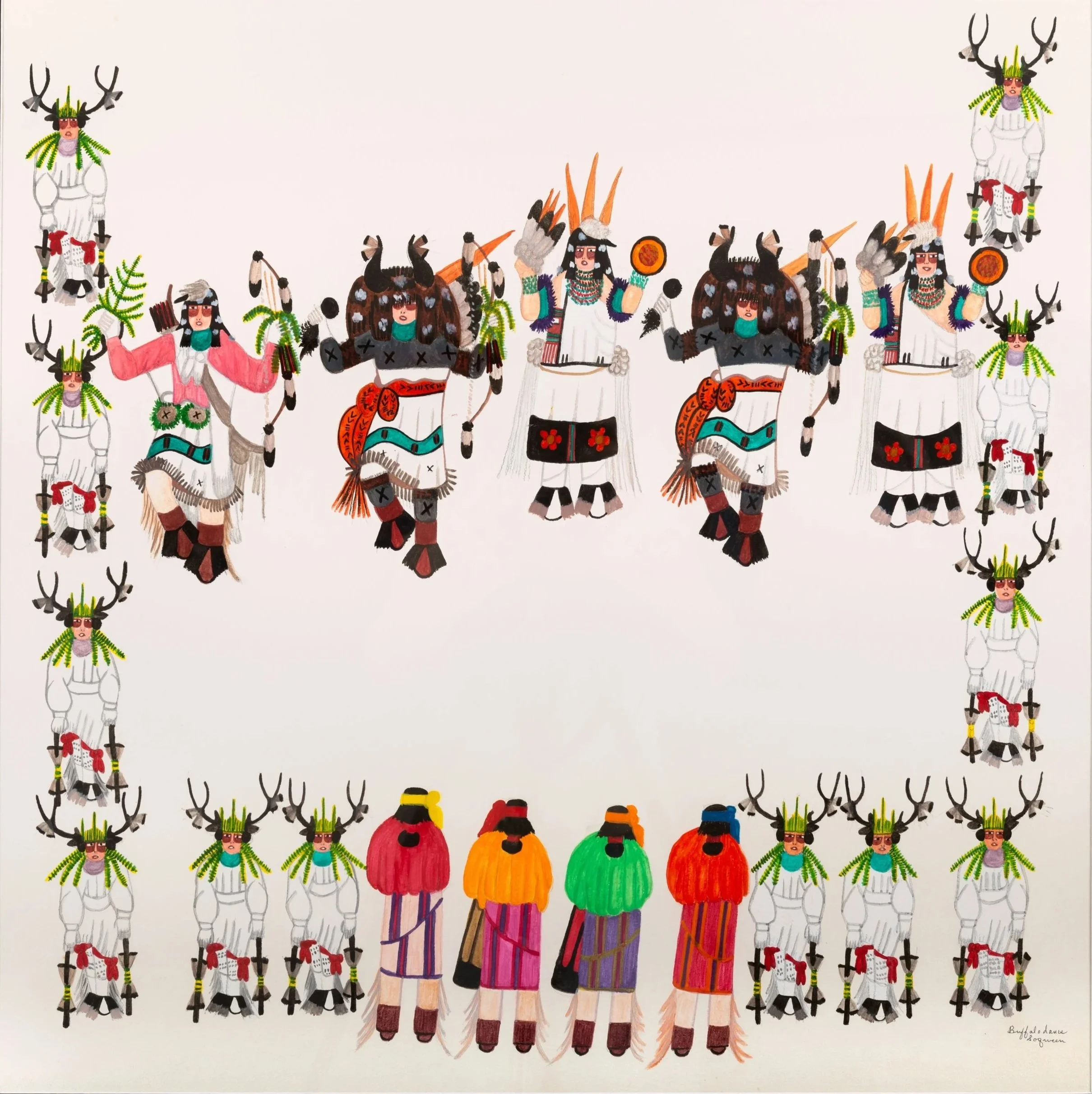
Buffalo Dance
- ENCARNACION PEÑA -
San Ildefonso Pueblo, 1902—1979
José Encarnación Peña, also known by his Tewa name Soqween (often rendered So-Kwa-Wi or So Kwa A Weh, “Frost on the Mountain”), was a painter from San Ildefonso Pueblo, New Mexico. Active from the 1920s onward, he became associated first with the early San Ildefonso painting school and later with the Santa Fe Indian School “Studio” style developed under Dorothy Dunn in the early 1930s. Peña’s watercolors focused on Pueblo ceremonial life—dances, musicians, and community scenes—drawn with delicate contour, rhythmic grouping of figures, and restrained color. He later produced murals and small figurative works, extending his visual language beyond works on paper.
Peña exhibited widely mid-century. His work appeared at the Renaissance Society at the University of Chicago in the exhibition Contemporary American Indian Painting (Jan. 4–23, 1958), and he was included in New York presentations such as the Riverside Museum in 1969. In New Mexico, he regularly showed at Santa Fe Indian Market and won first prize in painting at the 1959 Fiesta Indian Market. He also completed murals, including one documented at the Indian Pueblo Cultural Center in Albuquerque. Accounts and archival photographs show him active in these circles through the 1960s–70s, contributing to the visibility of Pueblo painting nationally.
Peña’s work is represented in major public collections. The Museum of Fine Arts, Houston holds his early gouache The Avañus of the East and West Fighting because of no rain (c. 1918–22), with recorded exhibition history at the museum; the Denver Art Museum preserves his watercolor Buffalo Dance (c. 1920s); and the Cleveland Museum of Art holds Dance Figure (1930s). The Smithsonian’s National Museum of the American Indian also includes his paintings, while the National Anthropological Archives houses photographs and documentation of his murals and of the dolls made by his wife, Patricia Peña.