
HELEN HARDIN
Helen Hardin (1943–1984) was a Santa Clara Pueblo painter. Works by Helen Hardin are available through Trotta-Bono Contemporary, a by-appointment gallery specializing in contemporary Native American art in Santa Monica, California.
— ARCHIVE —
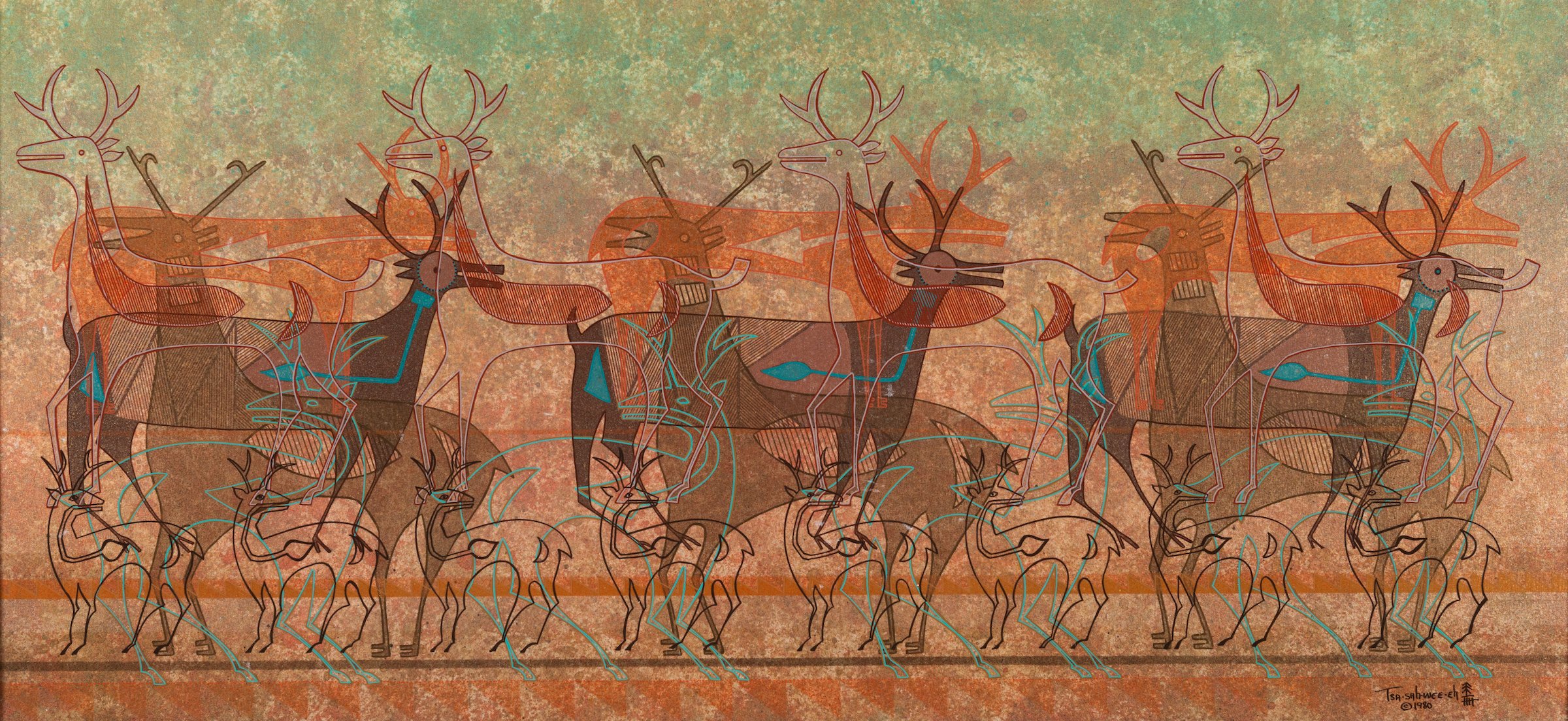
Passengers by the Storm

Hohokam Serenade of the Aged

- HELEN HARDIN (TSA-SAH-WEE-EH) -
Santa Clara Pueblo, 1943-1984
Helen Hardin (Tsa-sah-wee-eh, Tewa for “Little Standing Spruce”) was born May 28, 1943 in Albuquerque, New Mexico, and died June 9, 1984. The daughter of Santa Clara Pueblo painter Pablita Velarde and Herbert Hardin, Helen grew up surrounded by Pueblo painting traditions but struggled from an early age to define an independent artistic identity. She began selling work while still a teenager, studied in programs such as the Southwest Indian Art Project at the University of Arizona and later at the University of New Mexico, and quickly earned recognition in inter-tribal shows and regional exhibitions.
Hardin’s mature work blends Pueblo imagery and cosmology with a strikingly modern visual language. Working in layers of acrylic, ink washes, airbrush and etching techniques, she built luminous, jewel-like surfaces—often composed of tightly controlled geometric motifs, stippling, and concentric forms—that read both as abstract pattern and as symbolic depictions of figures, kachinas, and female-centered themes (her late “Woman Series” is a strong example). Throughout her career she used her Tewa name on early works, later signing variations of Helen Hardin as she navigated public expectations tied to her mother’s prominence and forged a distinctive voice that bridged figurative Pueblo painting and mid-20th-century modernism.
Hardin’s works are held in museum and institutional collections across the United States and remain represented in exhibitions and scholarship on 20th-century Native American art. Public collections listing her work include the Philbrook Museum, Albuquerque Museum, Crystal Bridges Museum of American Art, the Gorman Museum (UC Davis), and others that have shown her paintings, prints, and sketches; her work has appeared in market and museum shows since the 1960s and continues to appear in retrospective and regional exhibitions focused on Pueblo painters and women artists of the Southwest.