
MICHAEL KABOTIE
Michael Kabotie (1942–2009) was a Hopi painter. Works by Michael Kabotie are available through Trotta-Bono Contemporary, a by-appointment gallery specializing in contemporary Native American art in Santa Monica, California.
— ARCHIVE —

Untitled

Untitled
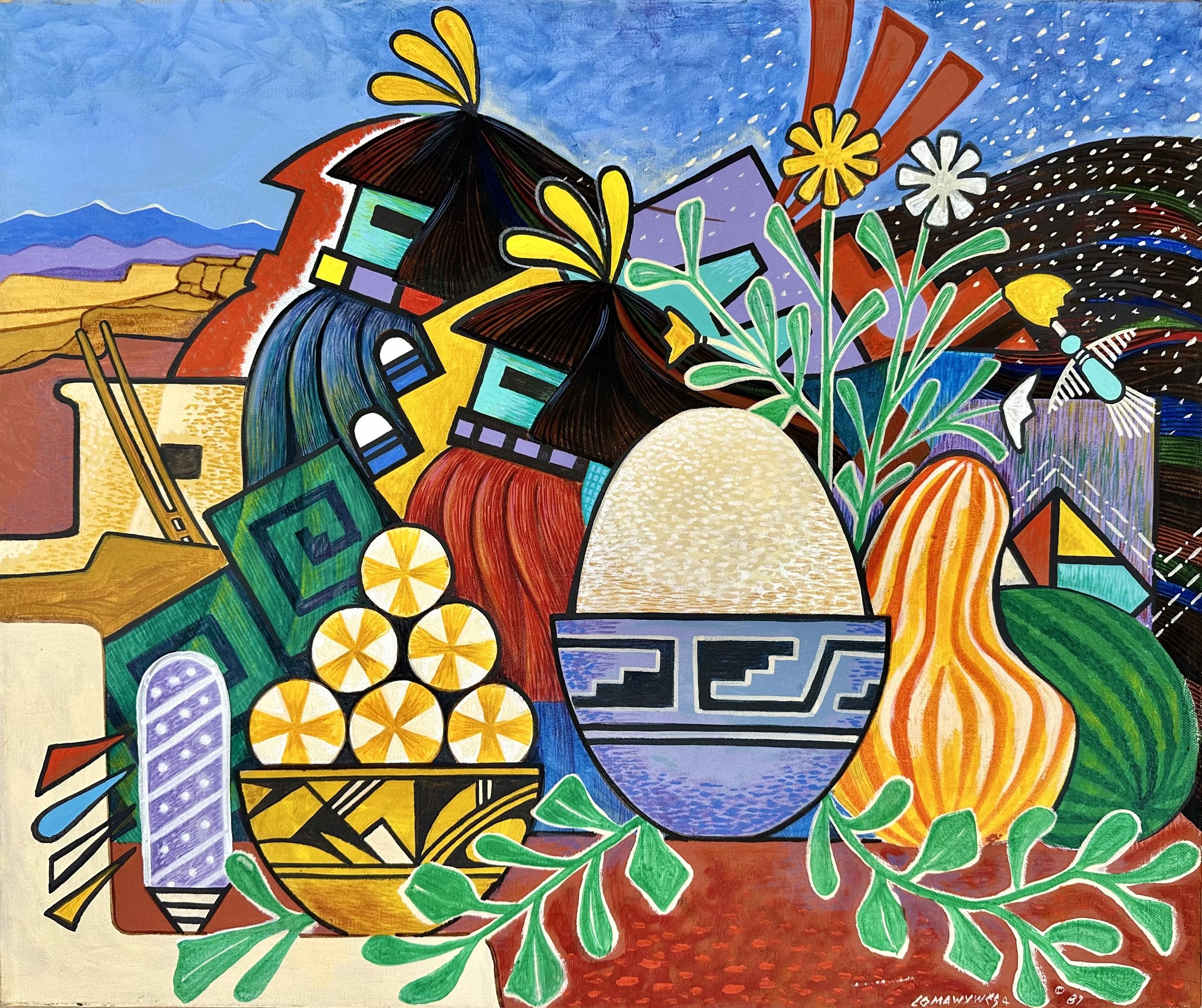
Kachina Harvest
– MICHAEL KABOTIE (LOMAWYWESA) –
Hopi, 1942-2009

Michael Kabotie was born September 3, 1942, in Shongopovi, Arizona to Alice Talayaonema, a traditional Hopi basket weaver, and the Hopi artist Fred Kabotie. He grew up in the village of Shongopavi and when the high school on the Hopi reservation closed, he moved and graduated from Haskell Indian School in Lawrence, Kansas in 1961. While in his junior year in high school, he was invited to spend the summer at the Southwest Indian Art Project at the University of Arizona, other participants included Fritz Scholder, Helen Hardin, Charles Loloma, and Joe Hererra (Hererra became a lifelong friend and a primary artistic mentor). Kabotie inherited his mother’s membership in the Snow Clan and he was initiated into the Hopi Wuwutsim Society in 1967. During this ceremony he was given the Hopi name, Lomawywesa (Walking in Harmony), which he used to sign his paintings and hallmark his jewelry.
In 1973, Michael Kabotie, Milland Lomakema, Neil Randall David Sr., Delbridge Honanie and Terrance Talaswaima formed the creative collective Artist Hopid. The group sought to break free from the constraints of solitary practice while honoring their rich cultural heritage. The members believed that collaborative energy would amplify their message with the creation of more rich, complex and potent artwork. Artist Hopid was established to support and promote Hopi art and culture, and to ensure that Hopi traditions and values would be passed down to future generations. They were intent to educate the world to the aesthetic and cultural values of the Hopi, to develop new ideas in Hopi art and to document Hopi history through the visual arts. As a group, the members were acclaimed for their massive, meticulous work that pushed the edge of what was then considered "safe" Indian art, which featured non-controversial subject matter such as animals, day-to-day reservation life scenes and landscapes.