
QUINCY TAHOMA
Quincy Tahoma (1921–1956) was a Navajo painter. Works by Quincy Tahoma are available through Trotta-Bono Contemporary, a by-appointment gallery specializing in contemporary Native American art in Santa Monica, California.
— SELECTED WORK —
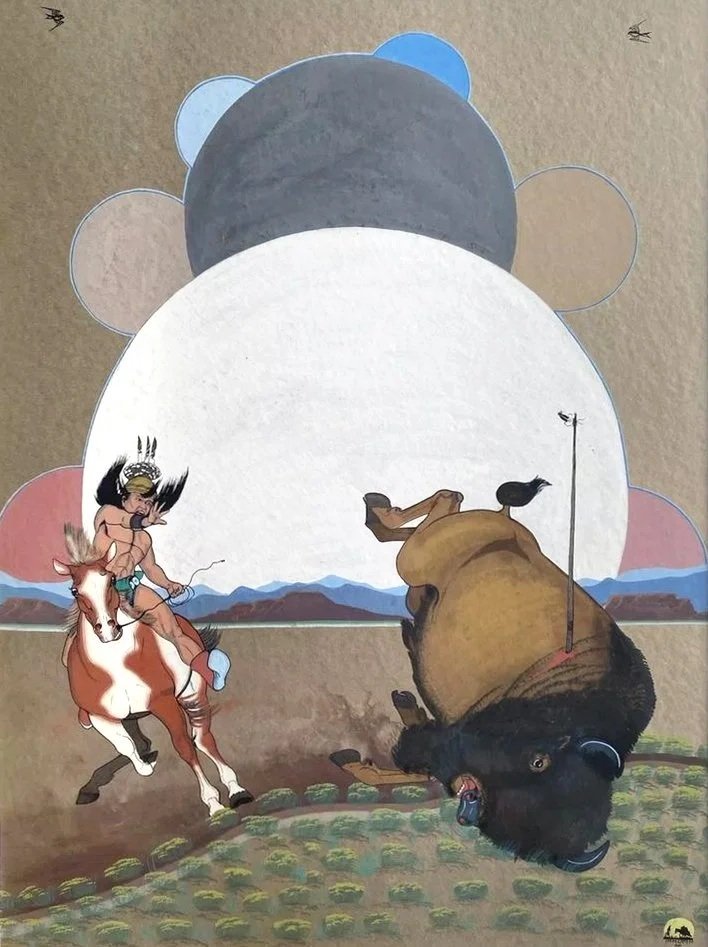
Untitled
- QUINCY TAHOMA -
Navajo, 1921–1956
Quincy Tahoma was a Navajo (Diné) painter whose striking, action-filled scenes of hunters, riders, ceremonial life and animals made him one of the most dynamic artists to emerge from the Santa Fe Studio School. Born into a traditional Navajo upbringing, Tahoma learned chants, sand-painting forms and horsemanship as a boy, experiences that later returned as subject matter in his work. He studied at the Santa Fe Indian School in the Dorothy Dunn “Studio” program from the mid-1930s into 1940, where he absorbed the flat, graphic conventions of the Studio style but quickly pushed them toward greater movement and narrative energy.
Tahoma worked primarily in watercolor, gouache, tempera and casein and became known for brilliant color, crisp line and highly animated compositions — riders and animals are often shown in mid-stride or combat, and his scenes frequently combine intimate Navajo subject matter with a theatrical sense of drama. Over the course of the 1930s–1950s he produced hundreds of works, ranging from small gouaches to larger tempera pieces and occasional carved panels.
Tahoma’s work is held in a number of public collections and continues to appear in museum and gallery shows and in the auction market. Institutional holdings that include his paintings or works on paper include the National Museum of the American Indian, the Gilcrease Museum, the Cantor Arts Center at Stanford, the San Diego Museum of Art, the Philbrook Museum of Art, the Fred Jones Jr. Museum of Art and the Phoebe A. Hearst Museum of Anthropology, among others; his works have been exhibited historically in Santa Fe and in regional and national exhibitions of Southwestern and Native American art, and more recent catalogues and monographs (including a full-color biography and catalogue raisonné) have helped renew scholarly and collector interest.